Grants
MBI-Funded Connected & Online Program through The Alliance for Digital Equity
Available Devices
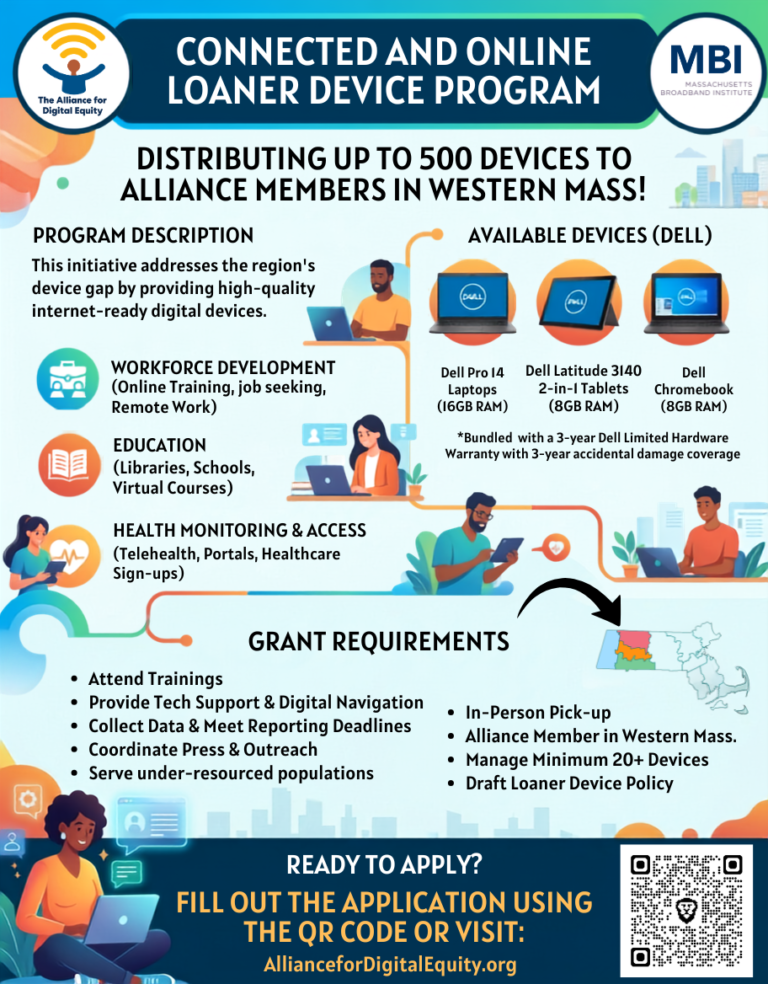
We have three device types available for distribution, all equipped with a 3-year Dell Limited Hardware Warranty with 3-year accidental damage coverage:
- Dell Pro 14 Laptops (16GB RAM): Bundled with 1 year of Microsoft 365 Basic, Acronis anti-virus.
- Dell Latitude 3140 2-in-1 Touch Tablets (8GB RAM): Bundled with 1 year of Microsoft 365 Basic, Acronis anti-virus.
- Dell Chromebook 3120 2-in-1 Touch (8GB RAM)
Project Focus Areas & Requirements
Per federal U.S. Treasury Capital Projects Fund (CPF) guidelines, all proposed partner projects must demonstrate how they will enable public access to devices across all three of the following domains:
- Workforce Development: Equipping public spaces or career hubs so jobseekers can build skills, craft résumés, complete online training, and pursue remote work.
- Education: Supplying devices to libraries, schools, or learning centers to support virtual coursework, homework help, adult education, and digital literacy training.
- Health Monitoring & Access: Providing devices to enable telehealth visits, assist with patient portal navigation, access health information, and support remote medical paperwork.
Partner Qualifying Terms
To qualify for a device allocation, participating organizations must meet the following criteria:
- Regional Focus & Membership: Must be a member of the Alliance and based in Western Massachusetts.
- Final Preference will be given to active members of the Alliance through monthly meeting participation. All applications must additionally fill out the Alliance membership form. https://docs.google.com/forms/d/1yuvzajwlNjSXwM2E6njjiZL5tCeHkkefBcAw-n6nTwY/viewform?ts=67e2d6fa&edit_requested=true&pli=1
- Target Audience: Must conduct active outreach and serve under-resourced populations.
- Minimum Fleet Size: Must request and manage a minimum increment of 20 or more devices of the same type.
- Logistics & Security: Must have a secure physical location to store the devices and be able to pick up the devices in person at Baystate (coordinated with the Alliance team).
- Systems & Policy: Must possess (or draft) a formal loaner device policy, and must utilize the Alliance’s check-out reservation system and scanning devices.
- Support & Training: Must attend program training with the Alliance and provide direct tech support and digital navigation services for their users.
- Coordinated Media: Must participate in coordinated press releases and formally acknowledge the Alliance/Baystate donation on websites, media, and program materials.
- Reporting: Must meet all reporting deadlines, tracking the number of unique users utilizing the computers and sharing narrative impact stories about their use. There will be 2 reporting dates required by grantees.
Loaner Device Interest Form
Applications will be accepted until Sept 8, 2026 at 6 pm.
Grants will be made on a rolling basis starting in late August.
To express your interest, please click the yellow button below.
Community Space Public Wi-Fi Program
Phase II
12.15.25 UPDATE
One of the most common concerns that non-profit organizations have, when considering expanding or adding community space public wi-fi, after the cost of purchasing and installing the system, is the on-going monthly subscription costs for providing wi-fi.
In response to this concern, we are excited to announce that grant funds can be used to pay for monthly Wi-Fi subscription service fees, which can be applied monthly or up to one-year paid in advance.
We hope this will remove a significant barrier for non-profit organizations considering applying for funds to increase access to the internet by providing new or expanded Wi-Fi in spaces used by community members. After receiving grant funds, organizations can choose to use the funds to pay for subscription Internet access/services on a monthly basis or for an entire year.
This project is part of a greater effort toward digital equity and closing the digital divide for residents of our region and is an initiative of the Alliance for Digital Equity at Baystate Health, as the recipient of a Massachusetts Broadband Institute (“MBI”) Regional Partnerships Program grant.
The Community Space Public Wi-Fi Program will provide funds to purchase wireless network hardware and install it to expand internet access in public spaces. Funding as part of these grants will also include resources to hire a vendor independently or through the Alliance. Our goal is to help organizations increase access to the internet by providing new or expanded Wi-Fi in spaces used by community members.
To that end, we are also connecting grantees with regional Digital Navigators who will meet with organizations, learn about their needs, and provide linkages to digital skills, devices, hotspots, and affordable internet solutions to benefit community members. Through connections with Digital Navigators, we hope to advance digital equity and provide an ongoing way for grantee organizations to share individual and collective impact stories that emerge from the Community Space Public Wi-Fi Program, thus helping to support and promote sustainable digital access and equity programming going forward.
Community Space Public Wi-Fi Program Grantee, Phase I
Berkshire South Regional Community Center
“We know that every one of our constituents and every staff member continues to benefit from the increased digital equity through the Community Space Public Wi-Fi program and the expanded consistent access to robust Wi-Fi service.
Beneficiaries include those with disabilities; ESL populations; elderly individuals and youth in education programs; and participants in financial literacy classes, mental health first aid, and other courses reliant upon digital training and access.
We are deeply thankful for this grant. It has been a major improvement in our functionality and expands our ability to serve our community and positions us well to maintain and upgrade to keep current with technological advances as we grow.”